
Understanding Compound Interest: The Formula and Its Effects
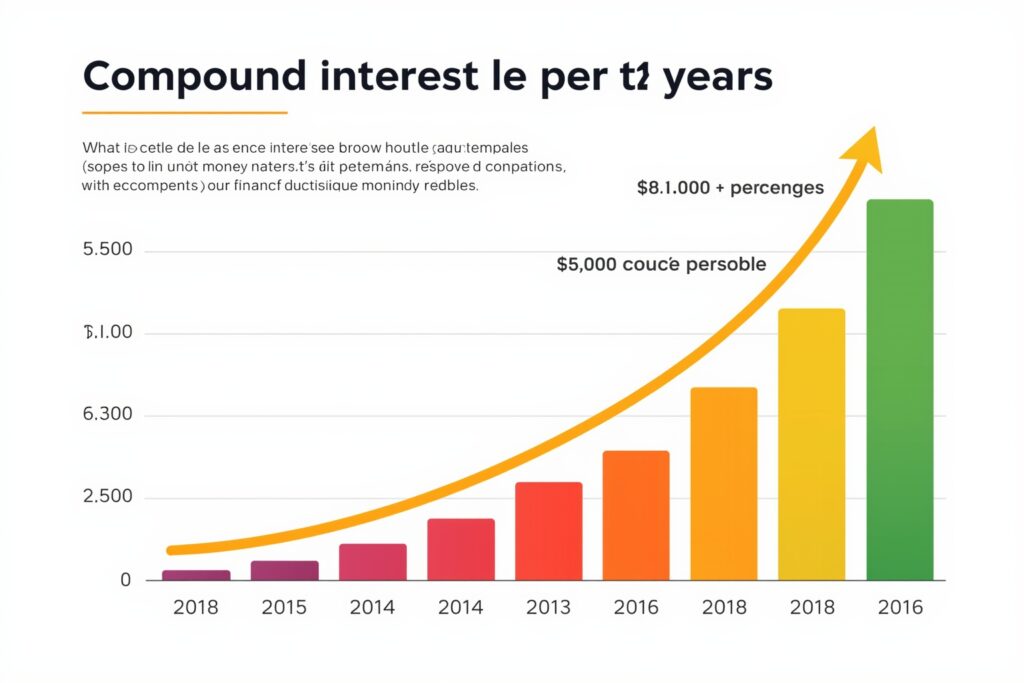
Compound interest means earning returns on both the initial amount and the accumulated gains. A €10,000 investment at 5% per year generates more revenue than simple interest. Each period adds a fraction of the previous interest to the principal, creating a snowball effect that accelerates over time and becomes a powerful lever for any financial acquisition strategy.
The standard formula is: Final Amount = Initial Capital × (1 + rate/n)^(n×t), where n represents the compounding frequency. Monthly compounding (n=12) accelerates growth compared to annual compounding. Choosing the right parameter can significantly increase the final result without additional investment. Visualizing these variations helps make informed decisions, especially over a multi-year investment horizon.
The Tylias calculator lets you explore these scenarios without complex inputs. You adjust the rate, period, and frequency to see the immediate impact on your capital. You can see how a low rate over a long period can outperform a high rate over a short duration, and how more frequent compounding amplifies the effect, with small differences adding up to produce notable gaps.
Understanding this mechanism is essential for anyone looking to optimize client acquisition or conversion. Compound interest illustrates how small upstream adjustments generate disproportionate downstream results. Integrating this logic into your financial forecasts allows you to refine growth targets and allocate resources more effectively.
Using the Tylias Calculator to Visualize Growth
The Tylias calculator offers an intuitive interface to enter your parameters and instantly observe the evolution of your investment. You can test different rates and periods, and see how the curve rises or stabilizes. The tool displays a clear chart that lets you compare multiple scenarios side by side—for example, a 4% rate vs. 6% over 10 years, or quarterly vs. annual compounding.
The simulator goes beyond pure projection: it highlights the limits of each assumption. It reminds you that historical rates don’t guarantee future returns and that inflation and taxes must be considered. This simulation remains valuable for illustrating the power of compound interest. You can export the data to incorporate into your business presentations, strengthening your pitch in meetings with potential clients.
By using this tool, you demonstrate concrete expertise to prospects. You show how a modest savings amount, left to grow steadily, can fund larger projects—boosting your credibility as a results-driven digital agency. It also fuels your editorial content by providing tangible examples for articles on acquisition and conversion.
To go further, you can pair this calculation with a custom website strategy. A high-performing site attracts more visitors, and strong conversion turns those visitors into qualified leads. Combining a compelling financial simulation with a solid technical approach maximizes your commercial impact.
Why This Matters for Your Acquisition and Conversion Strategy
Prospects often evaluate a service’s value based on quick, measurable returns. Compound interest, though abstract, illustrates a universal principle: initial efforts, when sustained, produce exponential results. A well-structured acquisition campaign can generate a similar effect, where each nurtured lead contributes to a broader client base. A customer’s lifetime value (LTV) follows a curve comparable to compound interest.
By visualizing this analogy with the Tylias calculator, you can demonstrate how investing in the right custom web development pays long-term dividends. A conversion-optimized site attracts more prospects, while a great user experience retains them. Acquisition and conversion thus become complementary levers, fueling each other to drive growth and improve your overall conversion rate without increasing ad spend.
To put this approach into practice, integrate A/B testing and track performance data. You continuously tweak elements to amplify the effect, much like compound interest that feeds on itself. Neglecting these optimizations limits your growth potential, because every unconverted lead represents lost interest. In a competitive landscape, leveraging this advantage can be the difference between a thriving business and one that stagnates.
Finally, communicating this logic to your clients builds trust. Showing how a well-designed digital strategy generates compounded returns reassures decision-makers. You position Tylias not just as a technical provider, but as a strategic partner for their financial success—opening the door to longer engagements and larger projects.
Conclusion: Turn Data into Opportunities
Mastering compound interest with the Tylias calculator gives you a powerful tool to illustrate the value of a patient, strategic approach. You can present compelling scenarios that link acquisition, conversion, and sustainable growth. Each visualization becomes a concrete sales argument for your prospects, reinforcing your expertise and credibility.
Ready to integrate this logic into your next digital project? Contact the Tylias team today to discuss how our custom website development and conversion rate optimization can amplify your results. By combining data-driven insights with top-tier technical execution, we turn potential into measurable performance.
Our team is available for a free, no-obligation consultation. Together, let’s build a strategy that generates compound interest for your acquisition and conversion, propelling your business toward exponential growth.
Conversion Rate Optimization (CRO)
External Resources
To learn more, see The Basics of Compound Interest on Investopedia and Introduction to Compound Interest on Khan Academy.
Ready to Take Action?
Let’s talk about your project and see how Tylias can help you turn this strategy into concrete results.
Get in Touch